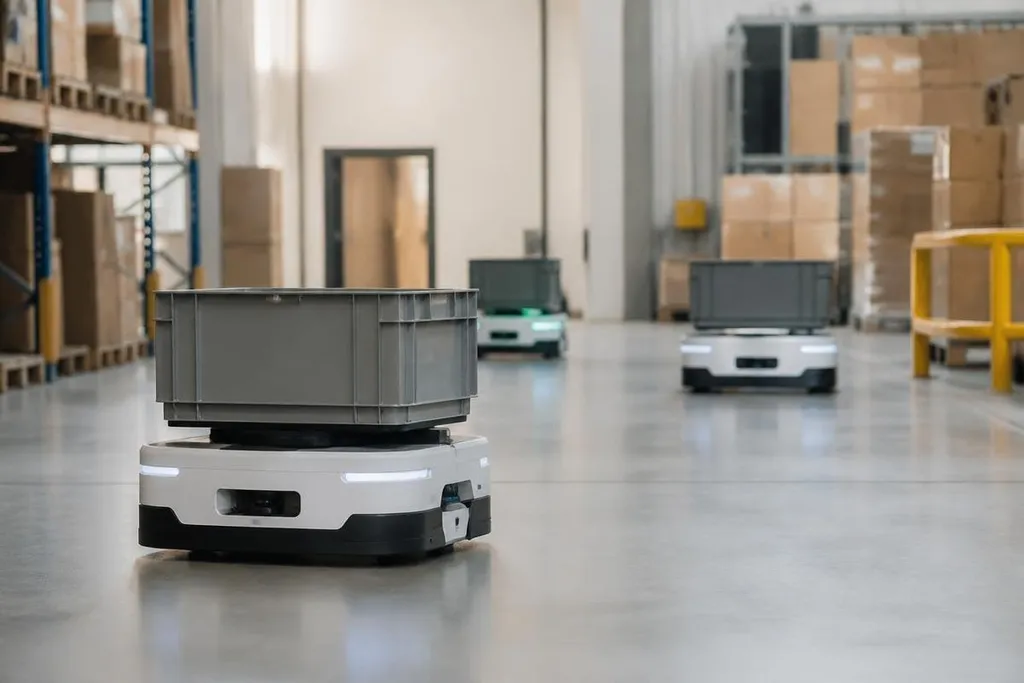
Mobile robots can move stock, inspect equipment, carry supplies, or collect data without a person walking beside it. That range gives companies several ways to build a business around the same basic system.
For a buyer, the useful question is practical: which task happens often enough, costs enough, or carries enough risk to justify a robot?
- Repeated transport is the clearest starting point.
- Inspection and data collection can create a second source of value.
- Service, software, and fleet support may matter as much as the robot itself.
Transport is the easiest business case to explain
Factories, hospitals, warehouses, and hotels all move items between fixed points. These systems can follow mapped routes, stop for people, and carry a defined payload between stations.
The business opportunity sits around that task. A company can sell the robot, rent access to it, install charging points, map the site, or manage the fleet after deployment. Each part needs different skills and carries a different cost.
Autonomous mobile robots often use LiDAR, cameras, and simultaneous localization and mapping, or SLAM. SLAM lets the robot build a map while tracking its position inside that map. The result is useful only when the site has clear routes, safe stopping rules, and work that repeats often.
That last point matters. A robot that moves one cart every few hours may have little value, even if the navigation works well. A robot that runs the same route through every shift has a clearer path to a business case.
Inspection creates value through data
Transport is visible, but inspection may create a wider service market. A robot can carry cameras, thermal sensors, microphones, or gas sensors through a plant and record changes over time.
A service company could use that system to inspect floors, pipes, storage areas, or electrical equipment. The customer may pay for scheduled reports rather than own the robot, which changes the sale from hardware to a recurring field service.
The hard part is proof. A camera feed does not fix a machine. The service has to show where an issue is, how it changed, and what action a technician should take next. Without that link, the robot has collected footage rather than useful work.
A paid inspection service starts with a work result: the robot finds a fault, records its location, and gives a technician a next step. Robot24.com can help buyers and founders check those details before they price the software, support, and human work around a mobile robot.
The robot is only one part of the sale
The system needs more than wheels and sensors. It may need a charging area, network access, safety checks, map updates, fleet software, and a person who can handle blocked routes or failed handoffs.
That creates room for integrators and support firms. They can connect the robot to warehouse software, hospital records, building systems, or production controls.
They can also train staff and set rules for shared spaces where people and robots use the same corridors. Remote operation is another possible service. When the robot reaches a case it cannot handle, a remote worker can guide it through the task.
That can help a pilot run across more situations, though the operator cost must stay below the value of the work saved. Software companies can sell fleet tools that assign jobs, track battery levels, record faults, and show where robots are waiting.
These tools matter more as a site adds machines, because a person cannot plan every trip by hand.
Where the business case breaks
Mobile robots work best when the task, route, and result are easy to define. Wet floors, poor lighting, lifts, narrow doors, changing layouts, and mixed traffic can add work that a sales demo leaves out.
Payload also sets a hard limit. A robot built to carry small bins cannot replace a system that moves heavy pallets. Battery charging adds another limit when the robot must run through long shifts without a planned stop.
The buyer should ask for a live task test, not only a video. The test should include blocked paths, a manual handoff, a low battery, and the exact software connection the site needs.
A practical buying checklist
Use these checks before choosing a business model:
- Name the task: record the route, load, handoff, and result the robot must complete.
- Count the work: measure trips per shift and the people-hours spent on them now.
- Check the site: include doors, lifts, floor changes, network coverage, and shared paths.
- Price the support: include mapping, software, charging, training, repairs, and remote operation.
- Set a failure rule: decide when a person takes over and how that event gets recorded.
- Test the data: confirm that inspection records connect to a real maintenance or safety action.
I'd start with one repeated task and a short paid pilot. That gives the buyer a real operating cost before a larger fleet or service contract follows.
The strongest opportunity may sit beside the robot: installation, fleet software, inspection reports, or the people who keep the system working after the demo ends.